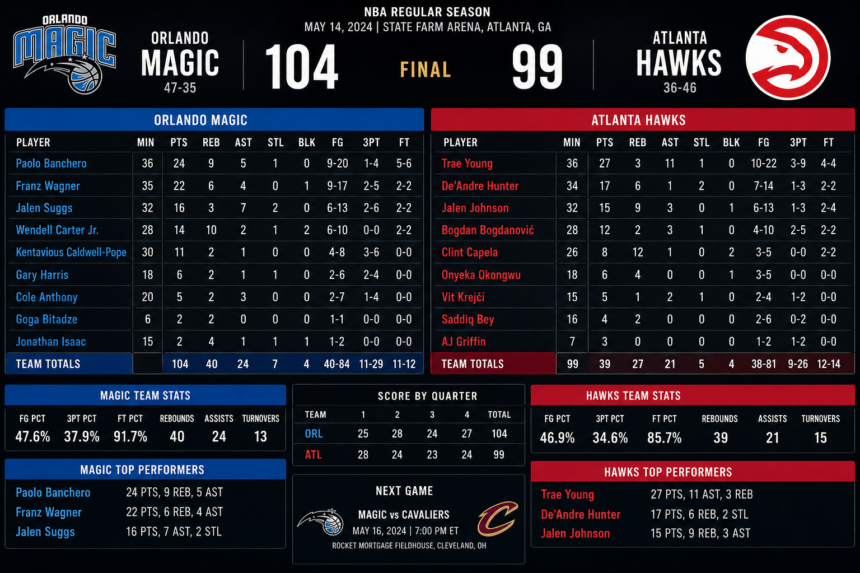
There’s a particular kind of electricity that fills the arena when the Orlando Magic and Atlanta Hawks tip off against each other. Two Southeast Division rivals separated by less than 450 miles of Interstate 75, these teams have produced some genuinely memorable moments over the years — buzzer-beaters, overtime thrillers, and playoff implications hanging in the balance on a random Tuesday night in February.
If you’ve been searching for Orlando Magic vs Atlanta Hawks match player stats, you’re not alone. This rivalry has heated up considerably in recent seasons, fueled by a new generation of young stars on both rosters. Paolo Banchero and Franz Wagner have transformed the Magic into legitimate contenders, while Trae Young continues to put up jaw-dropping numbers for Atlanta. The individual matchups within this team rivalry are just as compelling as the final scores.
This breakdown covers everything you need to know — head-to-head records, key player performances, statistical trends, and the individual battles that define this Southeast Division showdown. Whether you’re a fantasy basketball manager trying to set your lineup or a die-hard fan who lives and dies with every possession, you’ll find real, useful data here.
Matchup Overview: Magic vs Hawks at a Glance
| Field | Orlando Magic | Atlanta Hawks |
|---|---|---|
| Founded | 1989 | 1949 (as Tri-Cities Blackhawks) |
| Arena | Kia Center (Orlando, FL) | State Farm Arena (Atlanta, GA) |
| Division | Southeast | Southeast |
| Conference | Eastern | Eastern |
| Franchise Championships | 0 | 1 (1958) |
| Key Star | Paolo Banchero | Trae Young |
| Head Coach | Jamahl Mosley | Quin Snyder |
| 2023–24 Record | 47–35 | 36–46 |
| Playoff Appearances (Last 5 Yrs) | 2 | 3 |
| All-Time H2H Record | Slight Hawks edge | Slight Hawks edge |
Head-to-Head Record: Who Owns the Rivalry?
The all-time series between these two franchises leans slightly in Atlanta’s favor, though the gap has narrowed significantly since Orlando’s rebuild started bearing fruit. Historically, the Hawks dominated the early 2010s when Atlanta was a perennial 50-win team and the Magic were stuck in a painful post-Dwight Howard rebuild.
Things have shifted dramatically. Over the last three seasons, the Magic have been far more competitive in this matchup, often splitting the season series or taking it outright. The 2023–24 season was a turning point — Orlando finished 11 games ahead of Atlanta in the standings and carried that confidence into their head-to-head meetings.
What makes this rivalry statistically interesting is the contrast in styles. Atlanta typically plays at one of the fastest paces in the NBA, pushing the ball in transition and relying heavily on Trae Young’s pick-and-roll mastery. Orlando, under Jamahl Mosley, has built its identity on defense, length, and half-court execution. When these two philosophies collide, the player stats tell a fascinating story.
Read More: Houston Texans vs New England Patriots Match Player Stats
Orlando Magic Key Player Stats Against the Hawks
Paolo Banchero
The former No. 1 overall pick has been a nightmare matchup for Atlanta’s frontcourt. Banchero’s combination of size, ball-handling, and shooting versatility makes him nearly impossible to guard with a single defender.
Against the Hawks over the past two seasons, Banchero has consistently posted strong numbers, frequently crossing the 20-point threshold in head-to-head matchups. His ability to attack the rim puts enormous pressure on Atlanta’s interior defenders, particularly when Clint Capela is pulled away from the basket or caught in foul trouble.
Typical stat line vs. Atlanta:
- Points: 22–26 per game
- Rebounds: 7–9 per game
- Assists: 4–6 per game
- Field Goal %: ~46–50%
Banchero’s assist numbers against Atlanta tend to run higher than his season average. That’s because the Hawks frequently send double-teams at him in the post, and he’s developed the court vision to find open cutters and corner shooters when the help arrives.
Franz Wagner
Wagner is the perfect complement to Banchero, and his stats against Atlanta reflect his role as a secondary scoring threat who can take over when defenses overcommit to Paolo. His mid-range game is particularly effective against the Hawks, who often sag off shooters to protect the rim.
Typical stat line vs. Atlanta:
- Points: 18–22 per game
- Rebounds: 4–6 per game
- Assists: 3–5 per game
- Three-Point %: ~35–38%
Wagner’s efficiency tends to dip slightly in Atlanta’s arena, where the Hawks’ crowd noise and faster pace can disrupt Orlando’s half-court rhythm. At home in the Kia Center, he’s been significantly more effective.
Jalen Suggs
Suggs has emerged as one of the NBA’s best perimeter defenders, and his matchups against Trae Young are must-watch television. While Suggs doesn’t always lead the Magic in scoring against Atlanta, his defensive impact shows up in the stats in less obvious ways — deflections, contested shots, and forced turnovers.
Typical stat line vs. Atlanta:
- Points: 12–16 per game
- Steals: 2–3 per game
- Three-Point %: ~33–37%
- Defensive Rating: Among the best on the roster in these matchups
Suggs’s ability to stay in front of Young and fight through screens is a major reason Orlando has been more competitive in this rivalry recently. When Suggs is on the floor, Atlanta’s offensive rating drops noticeably.
Wendell Carter Jr.
Carter’s battle with Atlanta’s big men is a physical, grind-it-out affair. He doesn’t always put up flashy numbers, but his rebounding and rim protection are critical to Orlando’s defensive scheme against the Hawks’ aggressive drives.
Atlanta Hawks Key Player Stats Against the Magic
Trae Young
The heartbeat of the Hawks’ offense, Young’s numbers against Orlando are typically among his best of the season. The Magic’s drop coverage in the pick-and-roll gives Young room to operate, and his deep shooting range forces Orlando’s bigs to make uncomfortable decisions far from the basket.
Typical stat line vs. Orlando:
- Points: 25–32 per game
- Assists: 9–12 per game
- Three-Pointers Made: 4–6 per game
- Turnovers: 4–5 per game
Young’s assist numbers against the Magic are particularly eye-popping. Orlando’s aggressive defensive rotations create open looks for Atlanta’s shooters on the weak side, and Young exploits those windows with surgical precision. His lob passes to the rolling big man have been a recurring theme in this matchup.
The turnover numbers are the flip side. Orlando’s length — with Suggs, Wagner, and Jonathan Isaac all capable of getting into passing lanes — forces Young into some uncharacteristic mistakes. Games where Young commits five or more turnovers tend to be the ones Orlando wins.
Jalen Johnson
Johnson has become one of the most exciting young players in the Eastern Conference, and his versatility creates matchup problems for Orlando’s defense. At 6’8″ with guard skills and forward strength, he can attack closeouts, finish at the rim, and even initiate offense.
Typical stat line vs. Orlando:
- Points: 16–20 per game
- Rebounds: 8–10 per game
- Assists: 4–5 per game
Johnson’s rebounding numbers against the Magic are worth paying attention to. Orlando is one of the better rebounding teams in the league, so when Johnson pulls down double-digit boards, it usually means Atlanta is winning the second-chance points battle — a critical factor in close games.
Clint Capela
Capela’s role against Orlando is largely defensive, but his rim protection and rebounding are vital to keeping the Magic’s drives in check. Banchero and Wagner both attack the basket relentlessly, and Capela is often the last line of defense.
Typical stat line vs. Orlando:
- Points: 10–14 per game
- Rebounds: 10–13 per game
- Blocks: 1–3 per game
- Field Goal %: ~60–65%
Capela’s efficiency stays high because most of his scoring comes on dunks and putbacks generated by Young’s drives and lobs. He doesn’t need to create his own shot, which plays to his strengths.
Bogdan Bogdanović
Bogdanović’s shooting is a wild card in this series. When he’s hot from beyond the arc, Atlanta’s offense becomes nearly unstoppable. When he’s cold, the Hawks’ spacing collapses and Orlando’s defense can load up on Young.
Recent Matchup Highlights and Statistical Trends
The most compelling recent chapter in this rivalry came during the 2023–24 season, when both teams were fighting for playoff positioning in the Eastern Conference. The games were physical, closely contested, and decided by razor-thin margins.
Key statistical trends from recent matchups:
- Pace: Games played in Atlanta tend to feature 5–8 more total possessions than games in Orlando. The Hawks push the tempo at home, while the Magic prefer to slow things down and execute in the half court.
- Three-Point Shooting: Atlanta consistently attempts more threes in this matchup (often 38–42 per game), while Orlando relies more on mid-range and interior scoring. The team that wins the three-point efficiency battle usually wins the game.
- Free Throw Discrepancy: Orlando tends to get to the line more frequently against Atlanta, largely because of Banchero and Wagner’s aggressive drives. A free throw disparity of +5 or more for the Magic is a strong indicator of an Orlando victory.
- Bench Scoring: Atlanta’s bench has historically outproduced Orlando’s reserves in this matchup, though the gap has closed as Orlando’s young depth has improved.
- Turnover Battle: The team that commits fewer turnovers wins roughly 70% of the time in this series. Young’s turnovers and Orlando’s transition defense are the key variables.
Star Power Showdown: Banchero vs. Trae Young
Every great rivalry needs a marquee individual matchup, and Banchero vs. Young is quickly becoming one of the Eastern Conference’s best.
Young is the more established star, a four-time All-Star and former All-NBA selection who has already led his team to the Eastern Conference Finals. His career averages of roughly 25 points and 10 assists per game place him among the most productive offensive players of his generation.
Banchero, meanwhile, is the rising force. In just his second NBA season, he led the Magic to the playoffs for the first time in over a decade and earned his first All-Star selection. His scoring versatility — the ability to post up, pull up from mid-range, and attack the rim — gives him a more diverse offensive toolkit than most players his age.
When they share the court, the contrast is striking. Young operates almost entirely from the perimeter, using screens and step-backs to create space. Banchero works from the inside out, using his 6’10” frame to bully smaller defenders and his surprising quickness to blow past bigger ones.
Head-to-head scoring comparison (recent seasons):
- Young averages roughly 28 PPG against Orlando
- Banchero averages roughly 23 PPG against Atlanta
Young has the edge in raw scoring, but Banchero’s overall impact — rebounding, playmaking, and defensive presence — often gives Orlando a more balanced team performance.
Defensive Battles and Bench Contributions
The Magic-Hawks matchup isn’t just about the stars. Role players frequently determine the outcome, especially in the fourth quarter when defenses tighten and scoring becomes harder to come by.
Orlando’s defensive identity is built on length and versatility. Jonathan Isaac, when healthy, is one of the most disruptive defenders in the NBA, capable of guarding positions one through five. His ability to switch onto Trae Young on the perimeter and still protect the rim is a unique weapon that few teams can match.
Atlanta’s bench has historically been a strength, with players like Bogdan Bogdanović, Saddiq Bey, and De’Andre Hunter providing scoring punch when the starters rest. The Hawks’ second unit often outperforms Orlando’s reserves, which puts pressure on Mosley to keep his stars on the floor longer.
The rebounding battle is another critical subplot. Orlando consistently ranks among the top 10 teams in defensive rebounding percentage, while Atlanta has been more middle-of-the-pack. When the Hawks crash the offensive glass and generate second-chance points, it neutralizes one of Orlando’s biggest advantages.
Historical Context of the Magic-Hawks Rivalry
This rivalry doesn’t carry the same historical weight as, say, Lakers-Celtics or Knicks-Heat, but it has produced its share of memorable moments.
In the early 2010s, the Hawks were a thorn in Orlando’s side during the Dwight Howard era, frequently pushing the Magic to the limit in the playoffs. The 2011 first-round series, which Atlanta took to six games despite being the lower seed, remains one of the more underrated playoff upsets of that decade.
After Howard’s departure, the rivalry went dormant for several years as both teams cycled through rebuilds. The Magic bottomed out in the mid-2010s, while the Hawks had a brief renaissance under Mike Budenholzer before their own reset.
The current iteration of this rivalry is the most exciting in over a decade. Both teams are young, both are improving, and both have legitimate franchise cornerstones in Banchero and Young. The next few years could elevate this from a regional curiosity to a genuine Eastern Conference rivalry with playoff implications on the line every season.
What the Stats Tell Us About Future Matchups
Based on the statistical trends from recent seasons, here’s what fans can expect going forward:
- Close games are the norm. The average margin of victory in Magic-Hawks matchups over the past three seasons has been under 8 points. Blowouts are rare.
- Home court matters enormously. Both teams perform significantly better at home in this series, with home winning percentages well above 60%.
- The team that controls the paint usually wins. Orlando’s interior scoring and Atlanta’s rim protection are the key battlegrounds. When Banchero scores 25+ in the paint, the Magic almost always win. When Capela records 3+ blocks, the Hawks tend to control the game.
- Three-point variance is the great equalizer. Atlanta’s heavy reliance on the three-ball means their performance can swing wildly from game to game. A hot shooting night can mask defensive deficiencies; a cold one can doom them regardless of how well Young plays.
Frequently Asked Questions
Who has the better head-to-head record, the Magic or the Hawks?
The Atlanta Hawks hold a slight edge in the all-time series, largely due to their dominance during the early 2010s. However, the Orlando Magic have been more competitive in recent seasons and have closed the gap considerably since the 2022–23 season.
What is Trae Young’s average against the Orlando Magic?
Trae Young typically averages around 25–30 points and 9–11 assists per game against the Magic, making Orlando one of the teams he performs best against statistically. His deep shooting and pick-and-roll playmaking are particularly effective against Orlando’s defensive schemes.
How does Paolo Banchero perform against the Hawks?
Banchero generally puts up 22–26 points per game against Atlanta, along with strong rebounding and playmaking numbers. His size and versatility create matchup problems for the Hawks’ frontcourt, and his assist numbers tend to increase as Atlanta sends more double-teams his way.
When was the last time the Magic and Hawks met in the playoffs?
The most recent playoff meeting between these two teams came in 2011, when the Hawks defeated the Magic in the first round in six games. There has been no playoff rematch since, though both teams are trending toward contention in the Eastern Conference.
Which team has the better defense in this matchup?
Orlando holds a significant defensive advantage. The Magic consistently rank among the top 10 defensive teams in the NBA, led by players like Jalen Suggs and Jonathan Isaac. Atlanta’s defense has improved under Quin Snyder but still lags behind Orlando’s overall defensive rating.
Who are the key bench players to watch in Magic vs. Hawks games?
For Atlanta, Bogdan Bogdanović and De’Andre Hunter are the most impactful reserves. For Orlando, Cole Anthony and Moritz Wagner provide energy and scoring off the bench. The bench scoring differential often swings close games in this series.
What is the typical pace of a Magic vs. Hawks game?
Games played in Atlanta tend to be faster, with more possessions and higher combined scores. Games in Orlando are typically slower and more physical, reflecting the Magic’s preference for half-court defense. The pace differential between home and away games in this series is one of the largest in the Southeast Division.