The Denver Nuggets and Minnesota Timberwolves did not need much introduction before their 2026 playoff series. By the time Game 6 arrived in Minneapolis on April 30, the rivalry had already delivered momentum swings, huge performances and enough defensive tension to make every possession feel significant. With Minnesota leading the series 3-2, Denver entered the night facing elimination.
The Timberwolves finished the job.
Minnesota defeated Denver 110-98 to win the first-round series 4-2. Jaden McDaniels produced a playoff career-high 32 points and 10 rebounds, while Terrence Shannon Jr. added 24 points in a surprise start. Nikola Jokić led Denver with 28 points, 10 assists and nine rebounds, but Jamal Murray was held to just 12 points on 4-of-17 shooting. The numbers tell the story of a game in which Minnesota’s defense and interior scoring eventually overwhelmed Denver.
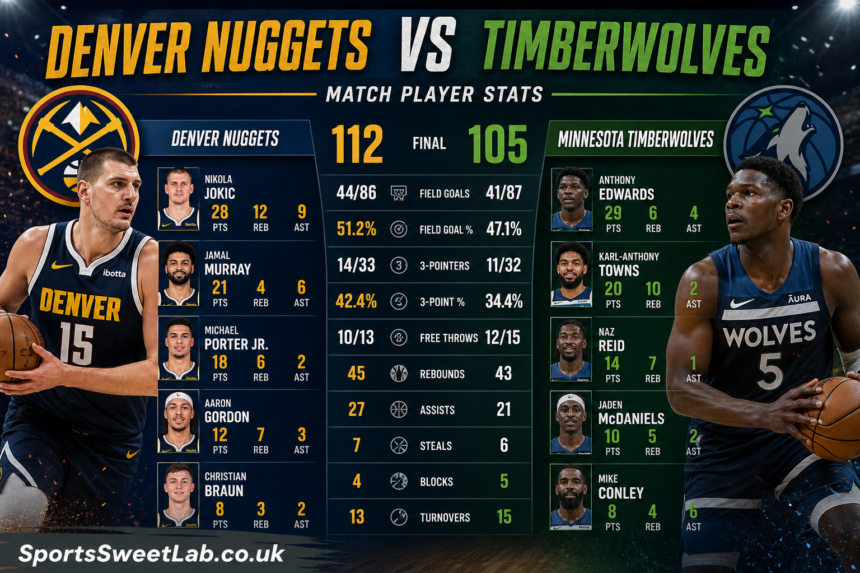
Denver Nuggets vs Timberwolves Match Player Stats: Game 6
Here is the key player production from the decisive game at Target Center.
| Player | Team | Minutes | Points | Rebounds | Assists | FG | 3PT |
|---|---|---|---|---|---|---|---|
| Jaden McDaniels | Timberwolves | — | 32 | 10 | — | — | — |
| Terrence Shannon Jr. | Timberwolves | — | 24 | — | — | — | — |
| Rudy Gobert | Timberwolves | — | 10 | 13 | 8 | — | — |
| Nikola Jokić | Nuggets | 43:24 | 28 | 9 | 10 | 11-19 | 1-5 |
| Cameron Johnson | Nuggets | 39:14 | 27 | 8 | 3 | 8-15 | 5-10 |
| Jamal Murray | Nuggets | — | 12 | — | — | 4-17 | — |
The most striking contrast was the production around the stars. Jokić nearly recorded another triple-double, and Johnson gave Denver an efficient scoring night, but Murray’s difficult shooting performance left the Nuggets without enough perimeter offense.
Minnesota, meanwhile, received a massive two-way performance from McDaniels. His 32 points represented a playoff career high, and his work against Denver’s perimeter threats was just as important as his scoring.
What the Denver Nuggets vs Timberwolves Match Player Stats Tell Us
The final score only tells part of the story.
Minnesota won the points-in-the-paint battle 64-40 and outrebounded Denver 50-33. That physical advantage became increasingly important as the game progressed.
The Timberwolves also finished with only seven turnovers, compared with 13 for Denver. Minnesota’s combination of interior scoring, rebounding and ball security allowed it to control the game without needing an extraordinary shooting night.
Denver actually opened the game with a 30-29 first quarter. But Minnesota responded by taking the second and third quarters and eventually created enough separation to prevent a late Nuggets comeback.
Jaden McDaniels’ defensive impact
McDaniels’ 32 points were the headline, but his defensive assignment made the performance even more significant.
Denver needed Jokić and Murray to carry much of its half-court offense. McDaniels spent long stretches chasing Denver’s perimeter players and made Murray work for nearly every clean look.
Murray finished 4-of-17 from the field, while Jokić was forced into a heavy offensive workload. The Nuggets star still produced 28 points, 10 assists and nine rebounds, but Minnesota’s defensive structure made it difficult for Denver to generate enough efficient scoring around him.
Rudy Gobert controlled the middle
Gobert’s stat line was quieter in scoring but important everywhere else.
He finished with 10 points, 13 rebounds and eight assists, while Minnesota used its size to dominate the glass. The Timberwolves’ 64-40 advantage in points in the paint showed how successfully they attacked Denver inside.
Gobert’s presence also affected how Denver could operate around Jokić. Even when he did not directly block a shot or record a steal, his size and positioning changed the space available around the basket.
Nikola Jokić vs Rudy Gobert: The Central Matchup
Few individual battles in the Western Conference have received as much attention as Jokić against Gobert.
Jokić entered the 2026 season as one of the NBA’s most versatile offensive centers. His ability to score from the post, pass over double teams and stretch defenses with his shooting makes traditional center-on-center matchups difficult.
The 2026 regular-season meetings showed that challenge clearly. Across four regular-season games against Minnesota, Jokić averaged 35.8 points, 15.0 rebounds and 11.3 assists.
He also shot 13-of-20 against Gobert when directly guarded by him in those four regular-season meetings, according to Denver’s official playoff series preview.
That did not mean Minnesota lacked answers. The Timberwolves could change coverages, use help defenders and rely on their size behind the initial matchup.
The playoff series became a chess match rather than a simple Jokić-Gobert duel.
Jamal Murray’s Role Became Crucial
Murray has long been one of Denver’s most important playoff performers, particularly because of his ability to create offense alongside Jokić.
But Game 6 was one of his toughest nights.
He scored only 12 points while shooting 4-of-17, and McDaniels’ perimeter defense made it difficult for him to find the rhythm he usually seeks through pull-up jumpers, screens and movement.
That mattered because Jokić was already carrying a huge offensive responsibility.
The Nuggets needed another high-level scoring source to complement their center. Instead, Minnesota successfully forced Denver’s second major offensive option into a difficult shooting night.
Cameron Johnson Gave Denver a Major Scoring Lift
One of the brighter performances for Denver came from Cameron Johnson.
Johnson scored 27 points, shooting 8-of-15 from the field and 5-of-10 from three-point range. He also grabbed eight rebounds and contributed three assists.
His five made three-pointers were particularly valuable because Minnesota’s defense frequently collapsed toward Jokić.
When defenses load up around a dominant interior passer, open perimeter opportunities become critical. Johnson converted enough of those chances to keep Denver competitive, but Denver ultimately needed more scoring from its primary creators.
How the Series Changed After Game 1
The six-game series was anything but predictable.
Denver won Game 1 at home 116-105, with Jokić recording 25 points, 13 rebounds and 11 assists while Murray scored 30 points. Murray was perfect from the free-throw line, going 16-for-16. Anthony Edwards led Minnesota with 22 points.
Game 2 immediately changed the tone.
Minnesota overcame a 19-point deficit to win 119-114. Edwards scored 30 points and Julius Randle added 24, while Jokić finished with 24 points, 15 rebounds and eight assists. Murray again scored 30, but Denver’s fourth-quarter offense struggled.
The series then moved to Minnesota, where the Timberwolves took control.
By Game 5, Denver was fighting to stay alive. Jokić responded with 27 points, 16 assists and 12 rebounds, producing his 23rd playoff triple-double. Spencer Jones added 20 points, including a huge fourth-quarter stretch, as Denver won 125-113.
That forced Game 6.
Minnesota had the final answer.
2026 Playoff Series Player Production
Across the six-game series, Jokić remained Denver’s statistical centerpiece.
| Player | Team | PPG | RPG | APG | FG% |
|---|---|---|---|---|---|
| Nikola Jokić | Denver | 25.8 | 13.2 | 9.5 | 44.6% |
| Jamal Murray | Denver | 23.7 | 5.0 | 5.7 | 35.7% |
| Cameron Johnson | Denver | 14.2 | 3.2 | 2.3 | 50.0% |
| Julius Randle | Minnesota | 16.0 | 7.5 | 2.8 | 39.0% |
| Jaden McDaniels | Minnesota | 16.3 | 5.8 | 2.4 | 44.3% |
| Anthony Edwards | Minnesota | 21.6 | 5.7 | 2.7 | 42.8% |
Jokić averaged a near triple-double for the series, while Murray averaged nearly 24 points despite shooting only 35.7% from the field.
That combination illustrates Denver’s problem. The Nuggets had elite top-end production, but Minnesota’s defensive pressure made it increasingly difficult for Denver to get efficient offense from its supporting pieces.
The Injury Factor in the Series
The final two games were heavily affected by injuries.
Minnesota entered Game 5 without Anthony Edwards and Donte DiVincenzo, who had both been injured in Game 4. The Timberwolves also briefly lost Naz Reid during Game 5 after he rolled his ankle.
Denver had injury concerns of its own. Aaron Gordon and Peyton Watson missed Game 5.
By Game 6, Minnesota’s backcourt situation was still severely compromised. Ayo Dosunmu joined Edwards and DiVincenzo on the inactive list, forcing the Timberwolves to rely on unusual combinations and larger lineups.
That is where Shannon’s performance became so valuable.
Terrence Shannon Jr. Steps Into the Spotlight
Shannon’s 24-point performance came when Minnesota needed unexpected offense.
With several regular guards unavailable, the Timberwolves had to find scoring from different places. Shannon responded with an aggressive offensive performance that helped take pressure away from McDaniels, Randle and Gobert.
It was a reminder of one of the defining realities of playoff basketball: a series can change quickly when injuries remove established stars from the lineup.
Role players are suddenly asked to perform under the brightest possible lights.
The 2025–26 Regular-Season Head-to-Head
The rivalry had already produced several memorable regular-season meetings before the playoffs.
Minnesota lost all four regular-season meetings with Denver:
| Date | Result |
|---|---|
| Oct. 27, 2025 | Denver 127, Minnesota 114 |
| Nov. 15, 2025 | Denver 123, Minnesota 112 |
| Dec. 25, 2025 | Denver 142, Minnesota 138 OT |
| Mar. 1, 2026 | Denver 117, Minnesota 108 |
The Christmas Day meeting was particularly explosive. Denver won 142-138 in overtime, highlighting how much offensive firepower existed on both sides.
The regular-season results, however, did not carry over cleanly into the playoffs. Minnesota eventually won the postseason series 4-2.
That contrast is one of the reasons the matchup has become such an interesting Western Conference rivalry.
Why the Nuggets vs Timberwolves Matchup Is So Difficult
Several factors make this matchup unusually complicated.
1. Jokić creates matchup problems
A center who can score efficiently, rebound and function as an elite passer forces defenses to make uncomfortable choices.
Double him and he can find shooters. Play him straight up and he can attack one-on-one.
2. Minnesota has unusual defensive size
Gobert protects the rim while McDaniels provides length on the perimeter. That combination gives Minnesota options against both interior and perimeter attacks.
3. Murray changes Denver’s ceiling
When Murray is hitting difficult jumpers and creating shots late in the clock, Denver becomes much harder to defend.
When his shooting percentage drops, much more pressure falls onto Jokić.
4. The games often become physical
The 2026 series featured technical fouls, hard defensive possessions and several heated moments.
That physicality can disrupt offensive rhythm, particularly when a team depends on precise half-court execution.
Denver Nuggets vs Timberwolves: Recent Rivalry Timeline
2022–23: Both teams emerge as significant Western Conference contenders.
2023–24: Minnesota eliminates Denver in the Western Conference semifinals after overcoming a 20-point Game 7 deficit.
2024–25: Minnesota wins all four regular-season meetings.
2025–26 regular season: Denver wins all four regular-season meetings.
April 2026 playoffs: Minnesota wins the first-round series 4-2.
April 30, 2026: Minnesota closes the series with a 110-98 Game 6 victory.
That back-and-forth history helps explain why individual Denver Nuggets vs Timberwolves match player stats have become so closely followed. A single matchup can look completely different from the previous one.
What Fans Should Watch in Future Matchups
If these teams meet again, three statistical areas will deserve immediate attention:
- Jokić’s assists: High assist totals usually indicate that Denver is successfully using his passing to punish defensive pressure.
- Murray’s shooting efficiency: His field-goal and three-point percentages can dramatically change Denver’s offensive ceiling.
- Minnesota’s rebounding and points in the paint: When the Timberwolves control the interior, they can reduce Denver’s margin for error.
The matchup is also about more than scoring. Turnovers, foul trouble, offensive rebounds and defensive assignments can decide the game before the final few possessions.
Frequently Asked Questions
Who led the Denver Nuggets vs Timberwolves match player stats in Game 6?
Jaden McDaniels led Minnesota with 32 points and 10 rebounds, while Nikola Jokić led Denver with 28 points, 10 assists and nine rebounds.
What was the final score of Nuggets vs Timberwolves Game 6?
Minnesota defeated Denver 110-98 on April 30, 2026, winning the first-round playoff series 4-2.
How did Jamal Murray perform in Game 6?
Murray scored 12 points and shot 4-of-17 from the field. Minnesota’s defensive pressure, particularly McDaniels’ work on the perimeter, made scoring difficult.
How did Nikola Jokić perform against Minnesota?
Jokić had 28 points, 10 assists and nine rebounds in Game 6. Across the six-game playoff series, he averaged 25.8 points, 13.2 rebounds and 9.5 assists.
Who was the standout Timberwolves player in Game 6?
Jaden McDaniels was the statistical standout, scoring a playoff career-high 32 points while also collecting 10 rebounds.
Did Denver win the 2025–26 regular-season series?
Yes. Denver won all four regular-season meetings against Minnesota during the 2025–26 season.
Who won the 2026 playoff series between Denver and Minnesota?
Minnesota won the Western Conference first-round series 4-2, finishing the series with a 110-98 victory in Game 6.
Why is the Nuggets-Timberwolves rivalry so competitive?
The matchup combines Jokić’s elite offensive versatility with Minnesota’s size, defensive length and physical style. Recent seasons have also produced dramatic playoff meetings, including Minnesota’s 2024 series victory and the 2026 six-game battle.