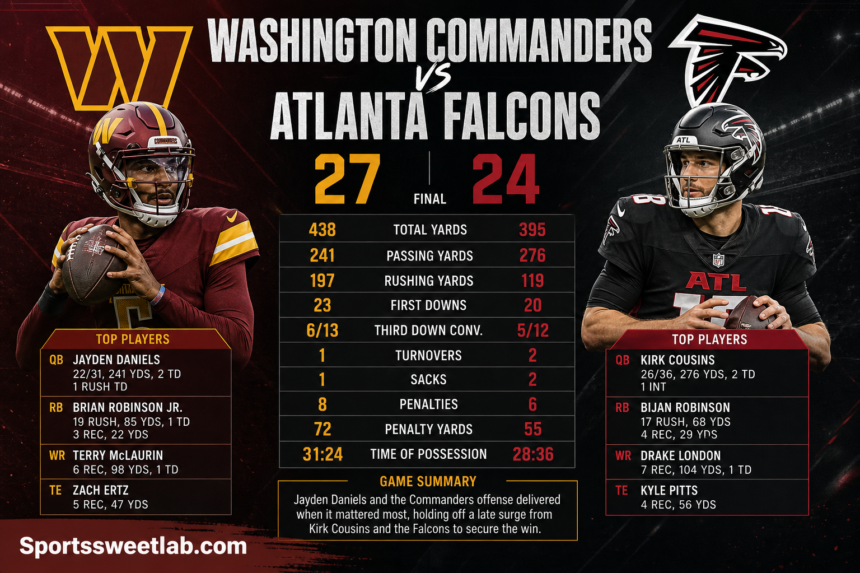
The Washington Commanders vs Atlanta Falcons match player stats tell a much more interesting story than the final score alone. Atlanta’s 34-27 victory on September 28, 2025, was built around a huge passing performance from Michael Penix Jr., explosive receiving from Drake London and Bijan Robinson, and enough rushing production to keep Washington’s defense under pressure. Washington stayed within one possession late, but Atlanta’s early advantage and 435 total yards proved decisive.
For Washington, Marcus Mariota delivered two touchdown passes and Deebo Samuel became the team’s leading receiver. The Commanders also produced some eye-catching runs, including a 48-yard burst by Chris Rodriguez Jr. Yet Atlanta controlled the ball for more than 34 minutes and ran 64 offensive plays compared with Washington’s 51.
Washington Commanders vs Atlanta Falcons Match Player Stats: Quick Summary
| Category | Washington Commanders | Atlanta Falcons |
|---|---|---|
| Final score | 27 | 34 |
| Total yards | 294 | 435 |
| Passing yards | 147 | 307 |
| Rushing yards | 147 | 128 |
| First downs | 17 | 24 |
| Time of possession | 25:45 | 34:15 |
| Turnovers | 1 | 1 |
| Plays | 51 | 64 |
| Penalties | 6 | 5 |
Atlanta’s advantage was particularly obvious through the air. The Falcons generated 307 passing yards, while Washington finished with 147. The Commanders compensated somewhat with 147 rushing yards, but Atlanta’s ability to sustain drives and create explosive pass plays kept Washington chasing the game.
Marcus Mariota’s Numbers for Washington
Marcus Mariota started at quarterback for Washington and completed 16 of 27 passes for 156 yards, with two touchdowns and one interception. He also added 20 rushing yards on two attempts.
His best moment came late in the fourth quarter when he connected with Deebo Samuel on a 24-yard touchdown pass. Washington then converted a two-point attempt through Zach Ertz, cutting the deficit to 31-24 with 8:48 remaining.
The Commanders eventually added another field goal, but Atlanta answered with one of its own before Washington could complete the comeback.
Washington’s key offensive performers
| Player | Role | Key stats |
|---|---|---|
| Marcus Mariota | QB | 16/27, 156 yards, 2 TD, 1 INT; 20 rush yards |
| Deebo Samuel | WR | 6 receptions, 72 yards, 1 TD |
| Chris Rodriguez Jr. | RB | 7 carries, 59 yards |
| Jacory Croskey-Merritt | RB | 7 carries, 47 yards |
| Luke McCaffrey | WR | 2 receptions, 21 yards, 1 TD |
| Zach Ertz | TE | 2 receptions, 21 yards |
The numbers show how Washington’s offense was spread across several contributors. Samuel supplied the biggest receiving workload, while Rodriguez and Croskey-Merritt produced efficient runs despite relatively modest workloads.
Deebo Samuel’s Performance Stood Out
Deebo Samuel finished with six receptions for 72 yards and a touchdown, giving Washington a reliable target throughout the afternoon.
His touchdown was particularly important because it briefly gave Washington momentum late in the game. Samuel caught Mariota’s 24-yard touchdown pass with 8:53 remaining in the fourth quarter, then Washington converted the ensuing two-point attempt.
Samuel also contributed as a runner, carrying the ball three times for nine yards. That versatility has long been part of his offensive profile, and it was visible again in Atlanta.
Chris Rodriguez Jr. Provided Washington’s Biggest Run
Washington did not dominate on the ground, but Chris Rodriguez Jr. made his limited carries count.
Rodriguez finished with 59 rushing yards on seven attempts, an impressive 8.4 yards per carry, including a 48-yard run. That explosive play accounted for a large portion of his total production.
Jacory Croskey-Merritt added 47 yards on seven carries, giving Washington two backs capable of creating chunk plays.
The problem was volume. Washington ran only 22 rushing plays, compared with Atlanta’s 37, while the Falcons also held a significant advantage in total offensive plays.
Atlanta Falcons Player Stats: Michael Penix Jr. Leads the Way
The biggest statistical performance of the game belonged to Michael Penix Jr.
Penix completed 20 of 26 passes for 313 yards, two touchdowns and one interception. His 12.0 yards per completion reflected an Atlanta passing attack that repeatedly found room downfield.
For a quarterback, completion percentage measures how many attempted passes are completed. Penix’s 76.9% completion rate in this game shows how efficiently he moved the Falcons’ passing game while still producing more than 300 yards.
Michael Penix Jr. game line
| Statistic | Total |
|---|---|
| Completions | 20 |
| Attempts | 26 |
| Completion rate | 76.9% |
| Passing yards | 313 |
| Passing TDs | 2 |
| Interceptions | 1 |
| Long pass | 43 yards |
| Passer rating | 122.9 |
Penix was not simply accumulating short completions. Atlanta repeatedly created explosive plays, and his connection with Drake London was especially productive.
Drake London vs Washington’s Secondary
Drake London was Atlanta’s leading receiver, finishing with eight catches for 110 yards and one touchdown. His longest reception went for 43 yards.
London’s touchdown opened the scoring for Atlanta late in the first quarter. Penix found him for a five-yard touchdown after Atlanta had already taken a 3-0 lead on John Parker Romo’s 38-yard field goal.
That early sequence mattered because Atlanta quickly built a 10-0 advantage. Washington spent the rest of the game trying to close the gap.
Bijan Robinson Was a Dual-Threat Problem
Bijan Robinson’s statistical line deserves special attention because his impact came both on the ground and through the air.
He rushed 17 times for 75 yards and one touchdown, while adding four receptions for 106 yards. That gave him 181 yards from scrimmage, including a remarkable 69-yard reception.
| Bijan Robinson category | Stats |
|---|---|
| Rushing attempts | 17 |
| Rushing yards | 75 |
| Rushing TDs | 1 |
| Receptions | 4 |
| Receiving yards | 106 |
| Receiving TDs | 0 |
| Total yards | 181 |
A player’s yards from scrimmage combine rushing and receiving yards. Robinson’s 181-yard total shows why Atlanta could attack Washington in different ways without relying exclusively on its quarterback.
His 14-yard rushing touchdown in the second quarter pushed Atlanta’s lead to 17-7.
Kyle Pitts Added Another Red-Zone Threat
Kyle Pitts also played a major role, catching five passes for 70 yards and a touchdown. His longest reception covered 26 yards.
Pitts scored on a seven-yard touchdown reception from Penix early in the third quarter. The score extended Atlanta’s advantage to 24-13 and gave the Falcons another answer whenever Washington threatened to build momentum.
With London outside and Robinson creating mismatches as a runner and receiver, Pitts gave Penix another reliable option.
Atlanta’s Running Game Kept Washington Honest
The Falcons did not need to throw on every down.
Robinson carried the ball 17 times for 75 yards, while Tyler Allgeier rushed 16 times for 51 yards and a touchdown. Allgeier’s 15-yard touchdown run came with only 14 seconds remaining in the third quarter and restored Atlanta’s 15-point cushion.
That balance helped Atlanta control possession. The Falcons ran 64 plays, compared with Washington’s 51, and held the ball for 34:15.
For defensive players, time on the field matters because sustained drives can wear down a unit physically and limit opportunities for the opposing offense.
Washington Commanders vs Atlanta Falcons Match Timeline
The game changed momentum several times, but Atlanta’s early advantage established the basic shape of the afternoon.
First quarter
- Atlanta opened with a 38-yard field goal.
- Penix then connected with London for a five-yard touchdown.
- Falcons led 10-0.
Second quarter
- Mariota found Luke McCaffrey for a five-yard touchdown.
- Robinson answered with a 14-yard rushing touchdown.
- Washington added a 43-yard field goal.
- Atlanta entered halftime ahead 17-10.
Third quarter
- Washington kicked two field goals.
- Penix found Pitts for a seven-yard touchdown.
- Allgeier added a 15-yard rushing touchdown.
- Atlanta led 31-16 after three quarters.
Fourth quarter
- Samuel caught a 24-yard touchdown pass.
- Washington converted a two-point attempt to make it 31-24.
- Atlanta kicked a 26-yard field goal.
- Washington added a 42-yard field goal.
- Final: Falcons 34, Commanders 27.
That timeline explains why the final score feels closer than some of the underlying statistics. Washington made a late push, but Atlanta had already built enough separation to protect its lead.
What the Team Stats Say About the Game
The most revealing comparison is not simply 34 points against 27. It is 435 total yards against 294.
Atlanta gained 141 more total yards, including a huge 160-yard advantage in passing. Washington’s 147 rushing yards helped narrow the overall gap, but the Commanders struggled to generate enough passing production.
Another important number was possession.
Atlanta controlled the ball for 34 minutes and 15 seconds, nearly nine minutes longer than Washington. That helped the Falcons run 13 more offensive plays.
Three numbers that explain Atlanta’s win
- 313 passing yards from Penix Jr. — the foundation of Atlanta’s aerial attack.
- 181 scrimmage yards from Bijan Robinson — a constant source of explosive plays.
- 34:15 time of possession — evidence of Atlanta’s ability to sustain offensive possessions.
Washington’s explosive plays kept the game competitive, but Atlanta was more consistent over the full 60 minutes.
2024 Commanders vs Falcons Meeting: A Very Different Finish
The September 2025 game was not the first recent meeting between these teams.
Washington and Atlanta met on December 29, 2024, in a memorable regular-season matchup at Northwest Stadium. Washington won 30-24 in overtime, with Jayden Daniels throwing the winning two-yard touchdown pass to Zach Ertz.
That game featured a completely different quarterback picture.
Daniels passed for 227 yards and three touchdowns while also rushing for 127 yards on 16 attempts. Bijan Robinson remained a major factor for Atlanta, rushing for 90 yards and two touchdowns.
The two games therefore provide an interesting snapshot of how quickly an NFL matchup can change.
| Meeting | Result | Washington QB | Atlanta QB | Notable performer |
|---|---|---|---|---|
| Dec. 29, 2024 | Washington 30-24 OT | Jayden Daniels | Michael Penix Jr. | Jayden Daniels |
| Sept. 28, 2025 | Atlanta 34-27 | Marcus Mariota | Michael Penix Jr. | Michael Penix Jr. |
The 2024 contest went to overtime, while the 2025 meeting was decided in regulation. Both games, however, featured major contributions from Robinson.
What Worked for Washington?
Washington’s strongest feature was its ability to create explosive rushing plays.
Rodriguez averaged more than eight yards per carry, while Croskey-Merritt averaged more than 6.7 yards per attempt. Samuel also provided a big-play element through both rushing and receiving.
The issue was sustaining that production.
Washington’s 294 total yards were not enough to match Atlanta’s 435, and the passing game produced only 156 yards through Mariota. Atlanta’s defense did give up some explosive plays, but its offense consistently put Washington under pressure by controlling possession and field position.
What Worked for Atlanta?
Atlanta’s offensive balance was the clearest difference.
Penix produced 313 passing yards, London surpassed 100 receiving yards, Robinson contributed 181 yards from scrimmage, and Allgeier scored on the ground. That is a difficult combination for a defense to contain for four quarters.
The Falcons also converted their strong yardage production into points. They scored in every quarter, while Washington was held scoreless in the opening period.
That early 10-0 hole ultimately forced the Commanders to spend most of the afternoon playing from behind.
Why the 2025 Matchup Matters Historically
The game was significant for the development of Atlanta’s young offensive core, particularly Penix.
The former Washington Huskies quarterback produced his first 300-yard passing performance against the Commanders, completing 20 of 26 attempts for 313 yards. His performance showed the potential for Atlanta to build its passing game around his accuracy and willingness to attack downfield.
For Washington, the game illustrated the importance of quarterback availability and offensive continuity. The Commanders had entered the 2025 season with Jayden Daniels as their quarterback, but Mariota handled the starting role in this particular matchup.
The result was therefore more than another regular-season box score. It captured two teams navigating changing offensive identities while relying heavily on emerging stars.
Frequently Asked Questions
Who won the Washington Commanders vs Atlanta Falcons game in 2025?
The Atlanta Falcons defeated the Washington Commanders 34-27 on September 28, 2025, at Mercedes-Benz Stadium.
How many passing yards did Michael Penix Jr. have?
Penix completed 20 of 26 passes for 313 yards, with two touchdowns and one interception.
How did Marcus Mariota perform against the Falcons?
Mariota completed 16 of 27 passes for 156 yards, two touchdowns and one interception. He also rushed for 20 yards.
Who was Washington’s leading receiver?
Deebo Samuel led Washington with six receptions for 72 yards and one touchdown.
How many yards did Bijan Robinson have?
Robinson recorded 75 rushing yards and 106 receiving yards, giving him 181 total yards from scrimmage. He also scored a rushing touchdown.
How many receiving yards did Drake London have?
Drake London caught eight passes for 110 yards and one touchdown. His longest reception was 43 yards.
Who had the most total offense in the game?
Atlanta produced 435 total yards, compared with Washington’s 294. Penix’s 313 passing yards were the largest individual offensive total through one category.
Did Washington and Atlanta play in 2024?
Yes. They met on December 29, 2024, when Washington won 30-24 in overtime. Jayden Daniels threw the overtime winning touchdown to Zach Ertz.
Final Takeaway
The Washington Commanders vs Atlanta Falcons match player stats reveal a game decided by Atlanta’s sustained offensive production rather than a single spectacular play. Penix’s 313 passing yards, London’s 110 receiving yards and Robinson’s 181 scrimmage yards gave the Falcons multiple ways to attack Washington.
Washington had its own explosive moments, particularly from Samuel, Rodriguez and Croskey-Merritt, and the fourth-quarter comeback attempt made the final minutes competitive. But Atlanta’s 435-294 edge in total yards and nearly nine-minute advantage in possession explain why the Falcons were able to hold on for the 34-27 victory.
For fans studying this matchup beyond the scoreboard, the central story is straightforward: Atlanta won the battle of sustained offense, while Washington relied more heavily on explosive individual plays to stay within reach.